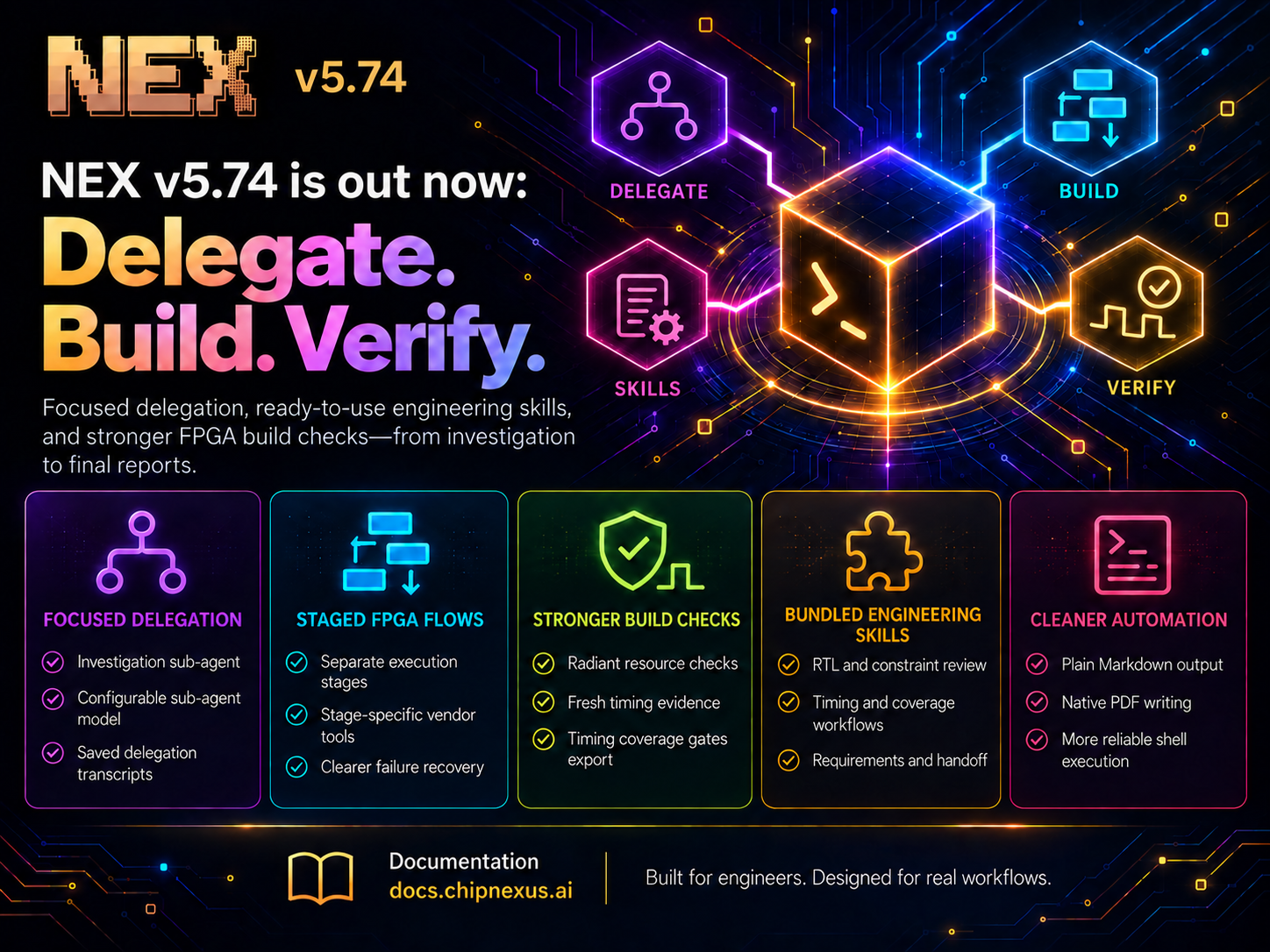
NEX v5.74 brings more structure to delegated engineering work, stronger checks on FPGA build results, and a bundled library of reusable skills. This release brings together the improvements since v5.67, including a dedicated investigation sub-agent, configurable models for delegated work, and plain Markdown output for automated workflows.
Getting Started / Updating NEX
New to NEX or updating from a previous version? Follow the installation and upgrade instructions in the official docs: Installation Guide.
FPGA Flows, One Stage at a Time
The FPGA manager now delegates vendor execution through explicit stages. Project setup, synthesis, implementation, and bitstream export are handled separately, with an additional mapping stage for Lattice Radiant.
Each delegation carries the facts and acceptance criteria needed for that stage. The Vivado or Radiant executor receives the vendor tools appropriate to its assigned step, and the manager uses the returned evidence to decide whether the flow can continue.
This also gives failures a clearer recovery path. When a stage fails, the executor returns the error to the manager. The manager decides what needs to change, applies or delegates the repair, and reruns the affected stages.
For larger designs, this makes it easier to track which steps completed, where a build stopped, and what evidence supports the next action.
Stronger Checks on Radiant Build Results
A completed tool run is only part of a successful FPGA build. NEX now checks Radiant implementation reports for signs that the expected design actually survived synthesis and implementation.
These checks cover:
- Suspiciously low resource usage that can indicate a design was optimised away
- Missing expected hard IP, such as PLL, PCS, PCIe, or oscillator blocks
- Mapping and routing errors
- Setup and hold timing failures
- Missing, stale, or incomplete timing evidence
Before bitstream export, NEX regenerates timing evidence from the routed database and checks that it still corresponds to that database. Export is refused when timing coverage is incomplete, including unconstrained clocks or clocked endpoints. A timing-check override cannot bypass this coverage check.
Radiant IP generation has also been strengthened. NEX uses the vendor’s generation wrapper and verifies the requested configuration, helping catch cases where generated IP does not match the intended settings.
Final reporting now includes a reconciliation step: agents are instructed to bring summaries and acceptance documents into agreement with the final vendor reports. This helps prevent an earlier resource estimate or timing result from remaining in the delivered documentation after the design has changed.
Engineering Skills, Ready to Use
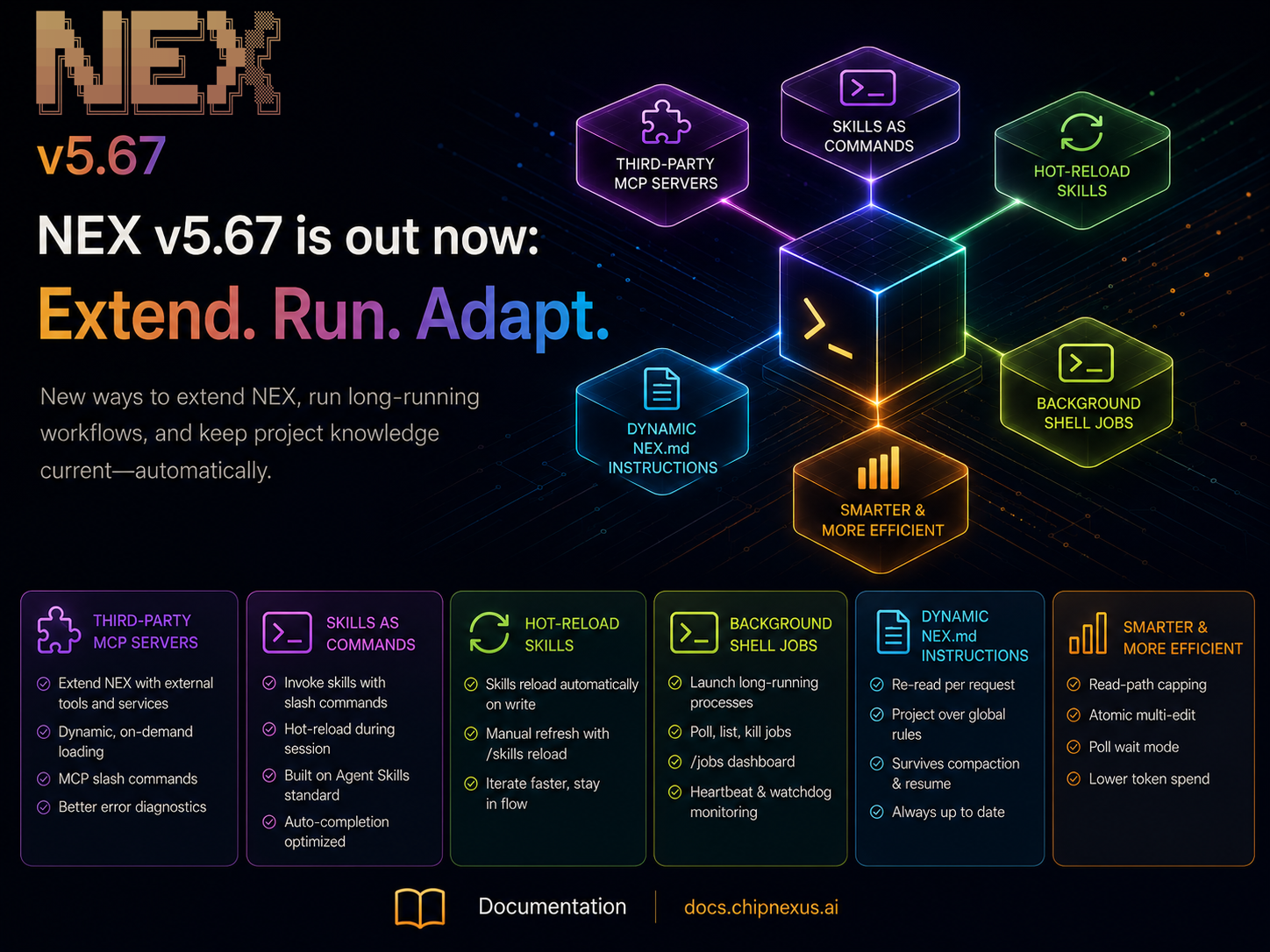
Building on the custom-skill commands introduced in v5.67, NEX now ships with a bundled set of engineering skills. Common workflows are available without first creating a project-specific skill library.
The shared skills include:
/dry-runfor a scoped synthesis check/rtl-reviewfor static RTL review/timing-closurefor diagnosing and iterating on timing failures/coverage-signofffor working towards agreed coverage targets/constraint-reviewfor reviewing timing constraints/clarify-requirementsfor resolving specification gaps/handofffor leaving work in a resumable state
Specialised agents also receive skills for their own responsibilities, including FPGA and ASIC flows, functional and formal verification, vendor implementation procedures, and HDL or platform migration.
Detailed procedures now live in these skills, while the agent prompts focus on role and operating rules. Agents can load the relevant procedure as work progresses, giving recurring engineering tasks a more consistent starting point.
More Focused Delegation
NEX now includes a general-purpose investigation sub-agent for focused research tasks. It can inspect repository files and, when configured, use web search to gather additional information. It returns a structured report with references and open questions to the coordinating agent.
This is useful for work such as tracing a module’s dependencies, locating relevant constraints, or investigating a tool failure before deciding how to proceed.
Delegated agents can also use a separately configured model through LLM_SUBAGENT_MODEL. When unset, they inherit the main model configuration. When set, the override selects a model within the configured provider, giving teams more control over how they allocate model capability across a workflow.
Sub-agent output is quieter by default, with transcripts saved under .nex/delegations/ for later inspection. Failure reporting is more explicit, and an empty report can no longer be accepted as a successful delegation.
Markdown Output for Automated Workflows
NEX can now return the final response as plain Markdown in headless mode. Combined with --prompt, the new --markdown-output option makes it straightforward to save an engineering response directly to a file:
nex --prompt "Summarise the RTL hierarchy in this project" --markdown-output > hierarchy.md
This is useful for scripted reviews, generated documentation, and workflows that consume readable reports. Startup banners and progress output are suppressed in this mode so the final response can be captured cleanly.
Licence information is now available on demand through /license, keeping routine startup and headless output focused on the task.
More Reliable Everyday Engineering
Several improvements across these releases address friction in longer sessions and shared EDA environments.
Executable discovery is now consistent across Vivado, Radiant, Questa, and VCS, including a fix for Questa installations that launch through a vsim symlink. Shell commands that try to read input no longer hang the foreground runner, and background descendants holding an output pipe open no longer prevent it from returning.
NEX also handles mentioned PDFs, images, and other binary files through the appropriate tools, includes a native PDF writer, and avoids the default request cap that previously interrupted some delegated document and image tasks.
Additional fixes improve terminal keyboard compatibility, recognise Amazon Bedrock inference profiles for prompt caching, and bound filesystem searches while rejecting special files. Custom-skill invocations also execute more reliably when their instructions are written in a documentation style.
NEX v5.74 gives engineering workflows clearer stages, reusable procedures, and stronger checks on the results they produce. From an initial investigation to the final FPGA reports, the focus is on making delegated work easier to follow and its outcomes easier to verify.