Getting Started / Updating NEX
New to NEX or updating from a previous version? Follow the installation and upgrade instructions in the official docs: Installation Guide.
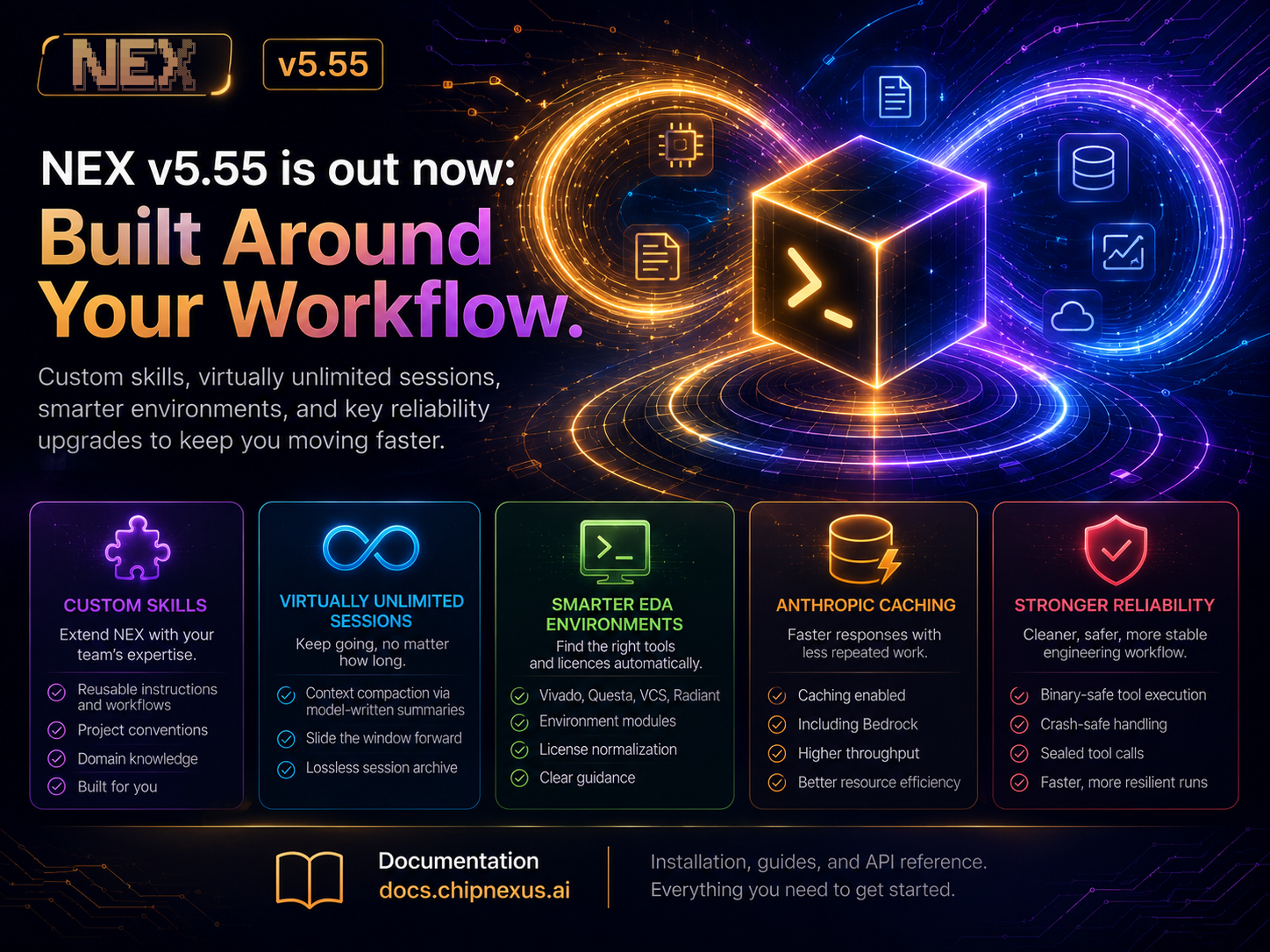
NEX v5.55 introduces custom skills, virtually unlimited sessions, and significantly better awareness of complex EDA environments.
The result is a more adaptable engineering assistant: one that can learn your preferred workflows, keep working through very large tasks, and locate the tools and licences it needs across real-world development environments.
Extend NEX with Custom Skills
Custom skills let teams package reusable instructions, domain knowledge, and supporting resources that NEX can apply when handling specialised tasks. Instead of repeating the same conventions, procedures, or project-specific guidance in every prompt, you can define them once and make them available as part of the working environment.
NEX follows the open Agent Skills specification, rather than introducing a proprietary skill format. Each skill is organised around a standard SKILL.md file and can optionally include scripts, reference material, templates, and other resources needed to perform a task.
Following this standard makes skills easier to create, maintain, and reuse across compatible agent platforms. Teams can build a shared library of engineering knowledge without tying that content exclusively to NEX.
Custom skills can capture:
- Internal engineering processes
- Project-specific conventions
- Repeatable design and verification workflows
- Team knowledge and best practices
- Guidance for specialised tools and methodologies
This makes NEX easier to shape around the way your organisation already works, while preserving the portability and familiar structure of an open standard.
Longer Sessions Without Losing Context
Complex tasks no longer need to end when the model’s active context window fills up.
NEX can now compact older conversation history into model-written summaries and slide the active context forward whenever necessary. Because this process can be repeated throughout a session, NEX can continue working far beyond the limits of a single model context window.
The complete conversation remains preserved in a lossless session archive, while the active context retains the decisions, findings, and instructions needed to continue the task. When the active window approaches its limit again, NEX can compact it once more and keep moving forward.
In practice, this makes sessions virtually unlimited. Long workflows can continue without requiring users to restart, manually summarise earlier work, or reconstruct previous decisions.
This is particularly valuable for work involving:
- Large repositories and complex project structures
- Multi-stage debugging and implementation
- Iterative RTL or verification changes
- Extended autonomous workflows
Tasks spanning many tool calls, simulations, and intermediate results
Smarter EDA Environment Discovery
NEX v5.55 substantially improves how EDA tools and licences are discovered and configured.
A new environment-resolution engine can identify environment modules, resolve vendor-specific tool installations, and normalise licence variables for:
- AMD Vivado
- Siemens Questa
- Synopsys VCS
- Lattice Radiant
Resolved environments are cached for reuse, reducing repeated setup work during a session. NEX can also surface relevant modules to the active agent and guide it towards module discovery when a required tool is not already available on the system path.
This is particularly valuable in shared compute environments, where multiple tool versions are commonly managed through environment modules rather than fixed installations.
NEX also avoids silently falling back to an ambiguous shell tool when multiple module versions are available. Instead, it keeps the environment selection explicit and predictable.
Better Verification and FPGA Workflows
This release continues to strengthen NEX’s hardware engineering capabilities.
Radiant IP catalogue handling is now more robust, including improved catalogue parsing and more reliable IP installation and generation flows.
The verification agent and shell tooling have also been expanded, while NEX can now identify IEEE 1735 pragma-protected HDL and protected SystemVerilog packages. This helps agents recognise when source code is encrypted or intentionally unavailable instead of attempting to analyse it as ordinary HDL.
File patching has also become more tolerant of formatting differences through a new indentation-insensitive fallback.
Faster Anthropic Sessions
Prompt caching is now enabled for Anthropic models, including models accessed through Amazon Bedrock.
For workflows that repeatedly reuse substantial context, caching can reduce the amount of input that needs to be processed again across model requests. This is particularly useful in long engineering sessions involving large system prompts, project instructions, or recurring repository context.
More Resilient Sessions and Tool Execution
Several improvements in v5.55 focus on ensuring that unexpected tool failures do not compromise the wider session.
NEX now:
- Safely handles binary or non-UTF-8 shell output
- Prevents malformed output from crashing shell tools
- Seals incomplete tool calls when a run is aborted
- Guards tool crashes so a failed operation does not leave the session unusable
- Restores file-based logging
- Correctly handles
Ctrl+Cduring approval prompts on Linux - Improves compatibility with
cshandtcshmodule environments - Normalises custom-skill paths across Windows and Unix-style systems
Together, these changes make interrupted and error-prone workflows much easier to recover from.
NEX v5.55 makes the assistant more adaptable to your organisation, capable of sustaining virtually unlimited workflows, and more aware of the engineering environment around it.
Custom skills are only the beginning. They provide a foundation for increasingly specialised workflows that combine team knowledge, EDA infrastructure, and agent-driven automation.